 Download Free Sample
The foods application segment will remain the largest end-use category, accounting for 32.69% of the global market share in 2026. Foods industry is the dominating application segment of the heat-shrink sleeve labels industry worldwide. Heat shrink sleeves offer excellent protection against contamination, moisture, and tampering, which are crucial for maintaining the quality and freshness of food products. They create a tight seal around containers, which helps extend shelf life and ensures that the food remains uncontaminated from external factors.
Heat-Shrink Sleeve Labels Market Size, Share & Industry Analysis, By Material (Polyethylene, Polyvinyl Chloride, Polyethylene Terephthalate, Polystyrene, and Others), By Product Type (Bottles, Cans, and Jars & Containers), By Application (Foods, Beverages, Beauty & Personal Care, Pharmaceuticals, Homecare, and Others), and Regional Forecast, 2026-2034

(Offer valid till 30th Sep 2026)
Heat-Shrink Sleeve Labels Market Overview
 Listen to Audio Version
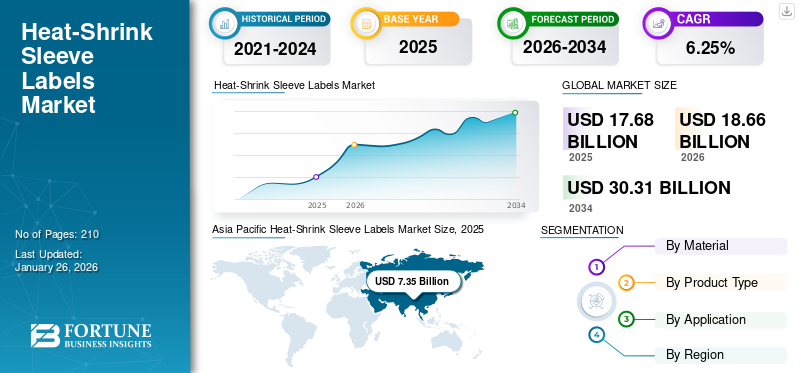
The global heat-shrink sleeve labels market size was valued at USD 17.68 billion in 2025 and is projected to grow from USD 18.66 billion in 2026 to USD 30.31 billion by 2034, exhibiting a CAGR of 6.25% during the forecast period. Asia Pacific dominated the heat-shrink sleeve labels market with a market share of 41.56% in 2025.
The heat-shrink sleeve labels market refers to the industry involved in the production, distribution, and utilization of these labels. These labels are made from materials that contract when exposed to heat, allowing them to conform tightly to the shape of the container to which they are applied. Commonly used in packaging for bottles, cans, and containers of various shapes and sizes, heat-shrink sleeve labels provide a visually appealing and durable solution for product identification, branding, and information display.
It plays a crucial role in the overall packaging and providing branding solutions for various products, including beverages, food items, pharmaceuticals, cosmetics, and household goods helping them to attain considerable market share. As consumer preferences for visually appealing packaging continue to grow, the market remains dynamic and responsive to evolving industry demands promoting the growth of the market.
The COVID-19 pandemic had a significant impact on various industries worldwide. The pandemic brought about a range of challenges and disruptions that affected the production, supply chain, demand dynamics, and overall business operations within these labels sectors. Companies had to reassess and reconfigure their supply chain strategies to adapt to the changing global landscape and mitigate the risks associated with such disruptions.
Download Free sample to learn more about this report.
HEAT-SHRINK SLEEVE LABELS MARKET Key Takeaways
 Global Market Size & Forecast
- 2025 Market Size: USD 17.68 billion
- 2026 Market Size: USD 18.66 billion
- 2034 Forecast Market Size: USD 30.31 billion
- CAGR: 6.25% from 2026–2034
 Market Share
- Asia Pacific dominated the heat-shrink sleeve labels market with a market share of 41.56% in 2025.
- The polyvinyl chloride (PVC) material segment is projected to account for 37.72% of the global market share in 2026.
- The bottles segment is expected to contribute 45.82% globally in 2026.
 Key Regional Highlights
Asia Pacific
The Asia Pacific market generated USD 7.35 billion in 2025, representing 41.56% of the global market landscape, and is expected to reach USD 7.83 billion in 2026.
North America
North America recorded a market size of USD 4.88 billion in 2025, capturing 27.57% of the global market share, and is projected to reach USD 5.15 billion in 2026.
Europe
In 2025, Europe represented USD 3.42 billion, accounting for 19.34% of the worldwide market, and is projected to grow to USD 3.58 billion in 2026.
U.S.
The market is projected to reach USD 4.63 billion by 2026, driven by strong demand for innovative labeling solutions across consumer goods and beverage packaging.
Japan
The market is projected to reach USD 1.73 billion by 2026, supported by increasing demand for premium packaging and advanced labeling technologies.
Read More

Heat-Shrink Sleeve Labels Market Trends
Digital Printing Technologies and Integration of Smart Packaging Features are Emerging as Key Trends in the Market
Digital printing technologies are revolutionizing the heat-shrink sleeve labels market. Traditional printing methods often involve time-consuming setup processes and high costs for small print runs. Digital printing allows for more flexibility, quicker turnaround times, and cost-effectiveness for shorter production batches. This trend is particularly beneficial for brands that frequently update their packaging or run limited-time promotions, as digital printing enables more efficient and responsive label production. The versatility of digital printing also facilitates variable data printing, allowing for personalized and targeted marketing efforts on product packaging. With the rise of the Internet of Things (IoT) and smart technologies, there is an increasing trend toward integrating smart features into packaging, including labels. Brands are exploring ways to incorporate QR codes, NFC (Near Field Communication) technology, and augmented reality elements into labels to engage consumers and enhance their overall brand experience. Asia Pacific witnessed a heat-shrink sleeve labels market growth from USD 6.50 billion in 2023 to USD 6.91 billion in 2024.
Download Free sample to learn more about this report.
Heat-Shrink Sleeve Labels Market Growth Factors
Application of Heat-shrink Sleeves in Diverse Industries is a Key Market Driver
The growth of the market is propelled by factors that cater to the evolving needs of brand owners, packaging designers, and consumers. The versatility of these labels extends their application across a wide range of industries, including beverages, cosmetics, pharmaceuticals, and household products. The labels are suitable for packaging containers of various shapes and sizes, making them adaptable to the diverse product portfolios of different sectors. As industries increasingly recognize the aesthetic and functional benefits of heat-shrink sleeves, the market experiences sustained growth driven by the expanding adoption of this labeling solution in new and existing product categories.
Innovation in Materials, Printing Technologies, and Customizability to Drive Market Growth
Advancements in materials and printing technologies contribute significantly to the growth of the market. Innovations in shrink film materials enhance label performance, offering features such as recyclability, environmental sustainability, and compatibility with various packaging substrates. Furthermore, the integration of digital printing technologies meets the evolving demands of brand owners for flexible and efficient label production, enabling cost-effective short runs, rapid prototyping, and high-quality graphics. Heat-shrink sleeve labels offer intricate and highly customizable designs, catering to the diverse branding requirements of different products and market segments. The rising demand for customizable and personalized packaging solutions reflects consumer preferences for unique and individualized products.
RESTRAINING FACTORS
Environmental Concerns and Compatibility Issues with Recycling Processes to Hamper Market Growth
The increasing emphasis on sustainability and environmental consciousness poses a significant challenge for the market. Many traditional heat-shrink sleeve labels are made from plastic materials that are not easily recyclable or biodegradable. As environmental regulations and consumer preferences lean toward eco-friendly packaging solutions, manufacturers face pressure to develop sustainable alternatives. The need for innovation to create biodegradable or recyclable heat-shrink materials adds complexity to the production process and may involve higher costs, hindering widespread adoption of such products in the market. The challenge is further exacerbated when these labels are used on recyclable packaging materials such as PET bottles. The labels may not easily be separated from the containers during recycling processes, leading to contamination and reduced recycling efficiency. This compatibility issue creates reluctance among environmentally conscious brands to use heat-shrink sleeve labels, thereby limiting the heat-shrink sleeve labels market growth.
Heat-Shrink Sleeve Labels Market Segmentation Analysis
By Material Analysis
Polyvinyl Chloride (PVC) Stands Out as the Leading Material Segment Due to the Distinct Benefits Offered by the Material
Based on material, the market is segmented into polyethylene, polyvinyl chloride, polyethylene terephthalate, polystyrene, and others.
The polyvinyl chloride (PVC) material segment is projected to dominate the heat-shrink sleeve labels market, accounting for 37.72% of the global market share in 2026. One of the primary reasons for PVC's dominance is its exceptional versatility. PVC labels can be easily adapted to fit containers of various shapes and sizes, making them an ideal choice for products with unique packaging requirements.
The flexibility of PVC allows for 360-degree graphics coverage, enabling vibrant and detailed branding that attracts consumer attention. Cost-effectiveness is another key factor contributing to PVC's prominence in the market. PVC is a relatively inexpensive material compared to alternatives, making it an attractive choice for manufacturers seeking cost-efficient solutions for labeling. The cost-effectiveness of PVC does not compromise quality or performance, making it a preferred option for businesses aiming to achieve high-quality packaging within budget constraints. These factors make them suitable for diverse market segments boosting their demand worldwide.
By Product Type Analysis
Bottles Segment Dominates due to Seamless Presentation on Retail Shelves
Based on product type, the market is segmented into bottles, cans, and jars & containers.
The bottles segment is expected to lead the market, contributing 45.82% globally in 2026. Bottles are the most dominating product type segment of the heat-shrink sleeve labels industry worldwide. The adaptability of such labels to various bottle shapes and sizes contributes to their popularity. Bottles come in a wide array of designs, ranging from standard cylindrical shapes to more intricate and unique forms.
Heat-shrink sleeve labels excel in conforming to these diverse contours due to their ability to shrink and adhere closely to the surface when exposed to heat during the application process. This conformity ensures a seamless fit, providing a visually appealing and polished appearance that is crucial for product presentation on retail shelves making bottles acquire a larger market share.
By Application Analysis
To know how our report can help streamline your business, Speak to Analyst
Food Packaging Segment Dominate the Market due to Transparency and Traceability Demands
Based on application, the market is segmented into foods, beverages, personal care & cosmetics, healthcare, electronics, and others.
Beauty & personal care is the second-largest segment of this market. The beauty and personal care industry heavily relies on packaging aesthetics to attract consumers. Heat shrink sleeves offer an elegant, high-quality appearance that enhances the visual appeal of cosmetic and personal care products. This sector often demands premium packaging solutions that reflect the brand’s image, making heat shrink sleeves an ideal choice. The foods segment is expected to hold a 34.19% share in 2024.
REGIONAL INSIGHTS
Based on geography, the market is analyzed across North America, Europe, Asia Pacific, Latin America, the Middle East and Africa.
Asia Pacific Heat-Shrink Sleeve Labels Market Size, 2025 (USD Billion)
To get more information on the regional analysis of this market, Download Free sample
Asia Pacific
The Asia Pacific market generated USD 7.35 billion in 2025, representing 41.56% of the global market landscape, and is expected to reach USD 7.83 billion in 2026. China and India are witnessing a surge in demand for packaged goods, influencing the expansion of the heat-shrink sleeve labels sector. Local packaging manufacturers are increasingly adopting these labels to cater to diverse product categories, ranging from cosmetics to food and beverages. The Japan market is projected to reach USD 1.73 billion by 2026, the China market is projected to reach USD 2.57 billion by 2026, and the India market is projected to reach USD 1.52 billion by 2026.
North America
North America recorded a market size of USD 4.88 billion in 2025, capturing 27.57% of the global market share, and is projected to reach USD 5.15 billion in 2026. North America is the second dominating region in the market. The U.S. and Canada are major contributors to the market, with a substantial presence of key players and a high level of technological innovation. The U.S. market is projected to reach USD 4.63 billion by 2026.
Europe
In 2025, Europe represented USD 3.42 billion, accounting for 19.34% of the worldwide market, and is projected to grow to USD 3.58 billion in 2026. Europe after North America is also one of the dominating regions and is expected to attain substantial growth over the forthcoming years. Germany, France, and the U.K. are key players in the region, leveraging advanced printing technologies and emphasizing regulatory compliance. The UK market is projected to reach USD 0.63 billion by 2026 and the Germany market is projected to reach USD 0.84 billion by 2026.
Latin America
In 2025, Latin America held 7.98% of the global market, reaching a valuation of USD 1.41 billion, and is projected to grow to USD 1.46 billion in 2026. Latin America will experience intense growth over the projected period driven by the expanding food and beverage industry and increasing consumer awareness. Brazil and Mexico are key contributors to the market, with a rising demand for visually appealing packaging.
Middle East & Africa
Middle East & Africa accounted for USD 0.63 billion in 2025, representing 3.55% of the global market share, and is projected to reach USD 0.65 billion in 2026. The Middle East & Africa is estimated to attain a moderate growth rate during the forecast period due to the increasing adoption of modern packaging solutions. The demand is particularly notable in the pharmaceutical and personal care sectors.
KEY INDUSTRY PLAYERS
Key Participants Focus on Offering Innovative Packaging to Expand their Customer Base
The global heat-shrink sleeve labels market is highly fragmented and competitive. Regarding market share, the few major players dominate the market by offering innovative packaging in the packaging industry. These major players in the market are constantly focusing on expanding their customer base across the regions and innovation.
Major players in the market include Berry Global Inc., Huhtamaki Oyj, Fuji Seal International, Inc., Amcor Plc, CCL Industries Inc., Avery Dennison Corporation, Klöckner Pentaplast Europe GmbH & Co. KG, and others. Numerous other players operating in the industry are focused on delivering advanced packaging solutions.
List of Top Heat-Shrink Sleeve Labels Companies:
- Berry Global Inc. (U.S.)
- Huhtamaki Oyj (Finland)
- Fuji Seal International, Inc. (Japan)
- Amcor Plc (Switzerland)
- CCL Industries Inc. (Canada)
- Avery Dennison Corporation (U.S.)
- Klöckner Pentaplast Europe GmbH & Co. KG (U.K.)
- Multi-Color Corporation (U.S.)
- C-P Flexible Packaging (U.S.)
- Resource Label Group, LLC (U.S.)
- Consolidated Label Co. (U.S.)
- Fortis Solutions Group (U.S.)
- Taghleef Industries (UAE)
- Multipack Labels (India)
- Akar Shrink Packs (India)
- C.I. TAKIRON (Japan)
- Shenzhen Golden Ocean Industrial Development Co., Ltd. (China)
- Traco Packaging (U.S.)
- HUBEI HYF PACKAGING CO., LTD. (China)
KEY INDUSTRY DEVELOPMENTS:
- Novemer 2023 – Berry Global launched a new version of its Omni Xtra polyethylene cling film for fresh food applications, which provides a high-performance alternative to traditional polyvinyl chloride (PVC) cling films.
- November 2023 – Autajon Group, acquired Royston Labels, a U.K.-based manufacturer of premium self-adhesive labels. This acquisition aimed to expand Autajon’s presence in the U.K. market, providing a strong platform for future growth.
- August 2023 – Amcor, announced the North American launch of curbside-recyclable AmFiber™ performance paper packaging, part of the company’s AmFiber portfolio. AmFiber performance paper is a high-barrier laminated paper suitable for most paper recycling streams.
- April 2023 – Brook + Whittle acquired the Custom Labels Group within Cenveo Worldwide Limited. The acquisition significantly enhances Brook + Whittle's position in e-commerce and digital label printing in North America.
- April 2022 – Fuji Seal, Inc. developed shrink labels made partly from PET resin recycled from used and waste labels through a chemical recycling probcess.
REPORT COVERAGE
The report provides detailed market analysis and focuses on key aspects such as key players, competitive landscape, product/service types, market segmentation, Porter's five forces analysis, and leading applications of the product. Besides, the report offers insights into the market trends and highlights key industry developments. In addition to the above factors, the report encompasses several factors that contributed to the market's growth in recent years.
Request for Customization to gain extensive market insights.
REPORT SCOPE & SEGMENTATION
|
ATTRIBUTE |
DETAILS |
|
Study Period |
2021-2034 |
|
Base Year |
2025 |
|
Forecast Period |
2026-2034 |
|
Historical Period |
2021-2024 |
|
Growth Rate |
CAGR of 6.25% from 2026 to 2034 |
|
Unit |
Value (USD Billion) |
|
Segmentation |
By Material
|
|
By Product Type
|
|
|
By Application
|
|
|
By Region
|
Frequently Asked Questions
According to Fortune Business Insights, the global market was USD 17.68 billion in 2025.
The global market is projected to grow at a CAGR of 6.25% over the forecast period.
The market size of Asia Pacific stood at USD 7.35 billion in 2025.
Based on the material, the polyvinyl chloride (PVC) segment leads the global market.
The global market size is expected to reach USD 30.31 billion by 2034.
The key market driver is the application of heat-shrink sleeves in diverse industries.
Berry Global Inc., Huhtamaki Oyj, Fuji Seal International, Inc., Amcor Plc, CCL Industries Inc., Avery Dennison Corporation, and Klöckner Pentaplast Europe GmbH & Co. KG among others.
Seeking Comprehensive Intelligence on Different Markets?Get in Touch with Our Experts
Speak to an Expert



- 2021-2034
- 2025
- 2021-2024
- 210
-
(Offer valid till 30th Sep 2026)
Download Free Sample
Jump to Content
Get 30-60 hrs Free Customization
Expand Regional and Country Coverage, Segments Analysis, Company Profiles, Competitive Benchmarking, and End-user Insights.
Packaging
Clients










Related Reports
-
US +1 833 909 2966 ( Toll Free )
-
Get In Touch With Us